WHAT PREVENTIVE MEASURES CAN BE TAKEN TO PREVENT THE MOST COMMON ‘SPINE INJURIES ‘

Spine injuries don’t always start with a sudden fall or heavy lift. It begin as failure in the spine’s supporting tissues. These failure develop silently from poor posture, sitting at one place for long hours, week deep stabilizer muscles, lack of mobility in hips and Thoracic region of spine. Over a period of time, these small failures accumulate reducing tissue tolerance. And one day you do small movement- tying a shoe laces, bend to pick up a small piece of paper and it triggers a big injury. Disc bulge, Muscle strain, Ligament sprain, Facet joint disfunction, Nerve compression (sciatica), Vertebral fractures- these are some back injuries. But before we proceed further, let’s understand the Anatomy of spine.
Spine is like a spring. It’s ‘S’ shaped. It’s composed of 24 movable seagaments called Vertebrae, right from the base of Skull to entire length of the trunk. The primary function of Vertebrae is to protect Spinal cord & to give upper body structural support. Each and every Vertebrae is designed to move freely and independently to each other. Each Vertebrae united by sequence of fibroligious inter Vertebral disks. It is strong but flexible. These disks are between each Vertebrae and they provide cushioning or shock absorbing functions between bones. These disks also provide space between our Vertebrae, which allows rooms for the nerves to exit from Spinal cord.
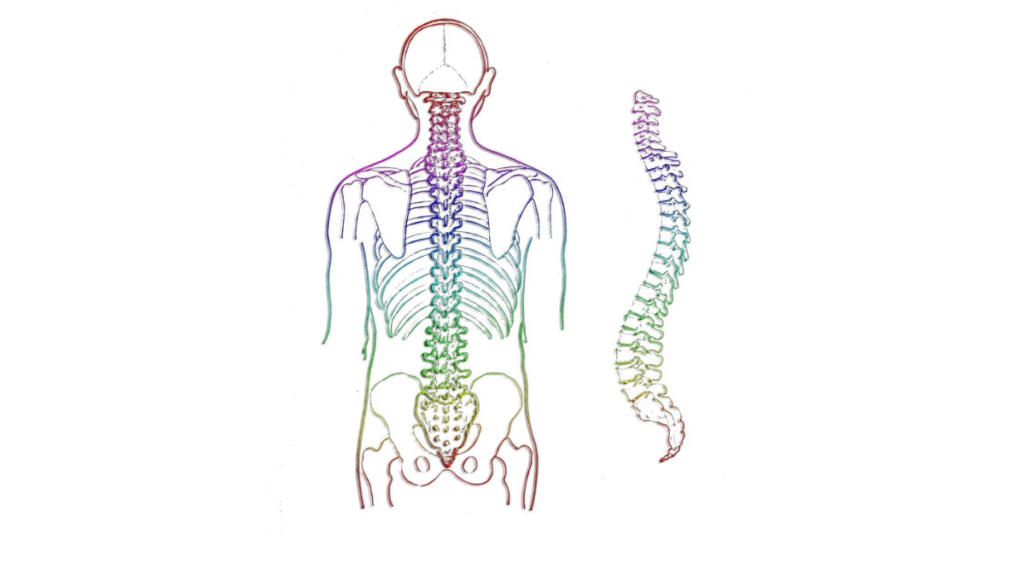
The Spine has four curves-
1) Cervical- Forward. It is made up of 7 Vertebrae.
2) Thoracic- Backward. It is made up of 12 Vertebrae.
3) Lumber- Forward. It is made up of 5 Vertebrae
4) Sacrum- Backward.
Thoracic and Sacrum curves are primary curves. Both are present in fetus.
Cervical and Lumber are secondary curves. Cervical appears 3 months later after birth & keep increases for about 9 months. Lumber appears
All the Vertebrae are similar in shape except 1 & 2 Cervical &, Sacrum & cocix – tail of Vertebrae.
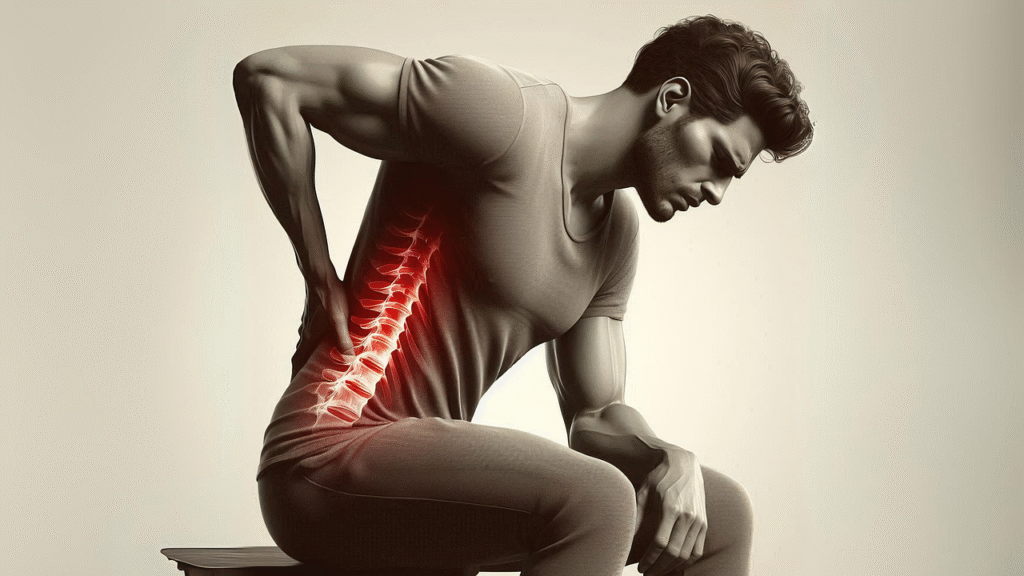
Spine injuries can varies from mild to severe and often have lasting effects on mobility and sensation.
Below given factors increases Spinal injury risk.
1) Hip mobility.
2) Week deep core muscles.
3) Fatigue based injuries.
4) Breathing disfunction.
5) High stress.
Types of Spinal injuries-
1) Spinal cord injuries (SCI)- It damages to the Spinal cord, leading to partial or complete loss of function. Complete SCI- Total loss of movement and sensation below the injury site. Incomplete SCI- Some functions remains below the injury level.
2) Spinal fractures- Breaks or cracks in Vertebrae, which can lead to Spinal cord damage or instability.
3) Herniated disc- The soft inner part of Spinal disc pushes out, compressing nerves.
4) Spinal Stenosis- It narrows the Spinal cord, often causing nerves compression.
5) Whiplash- Its caused in car accident, effects the neck and upper spine.
Level of Spine injuries-
1) Cervical (C1-C7)- affects the neck and can lead to paralysis.

2) Thoracic (T1-T12)- affects the chest and mid back.
3) Lumber (L1-L5)- affects the lower back, impacts on leg function.

4) Sacrum (S1-S5)- affects the Pelvis, bladder and bowel control.
Nerves can become impinged or pinched by disks. When nerve is pinched, muscles of back can go into spasm. Pain can radiate away from Spine. There are 3 degrees of radiation-
1) Pain radiates to butt.
2) Pain radiates to knee.
3) Pain radiates to foot.
When a nerve becomes damaged, muscles that it’s supplies
If pain radiates from the leg, or if you have numbness tingling or loss of muscle function, you must seek medical intervention immediately. If you wait for longer chances are there that you will have a permanent injury.
There are few steps which can followed consistently, can significantly reduce the severity of symptoms stemming from the lower back pain.
Move every 30 minutes- Sitting at one place for long hours can be dangerous. When you sit, 3/4th of body weight is on your lower back. And if you bent down to pick up a small piece of paper, it can injure your lower back.
Strengthen Spinal stabilisers- Do some exercises to strengthen your core muscles like-
Bird dog plank, Dead bug, Side plank, Hip bridge variations
Try to improve mobility in the areas like- Thoracic spine, Hip flexors, Rotators, Hamstring flexibility etc.
Train the hinge pattern- Try and learn to bend from hips, not from lower back. Hip hinge is protects your spine for life.
There are few steps which if you follow consistently, it can reduce the severity of symptoms stemming from back pain.
1) Reduce the inflammation- The recommended initial treatment is usually an oral anti-inflammatory and ice. But before using any drug, check with your physician. With internal anti-inflammatory, you can use external anti-inflammatory as well like ice. You can use flexible gel packs. Crushed ice in a zip lock bag also works well. If you are using a crushed ice, make sure it is crushed in to fine pieces. Don’t cover it with towel, otherwise it won’t penetrate deep enough to work. Using ice is staying mobile and flexible. Ice can make you little stiff, so stretch.
2) Improve seagamental alignment and mobility- Two most common problems that cause back pain are malalignment and fixation. A malalignment can occur as result of an injury as slipping or falling. If Vertebrae moves out from it’s normal position, it creates pain.
Traumatic fixation: Jamming of finger while catching the ball. Your finger could be jammed or sprained, but not broken, but it hurts and gets stiff and swollen. If you try to bend at one joint, rest of joint remains fix or immobile. Same principle applies on the spine.
Static fixation: Stiffness created by being in one position for prolonged periods of time. If you sit for long time without moving, your spine gets stiff. And if you bend to pick up a piece of paper, it can harm your back. The leverage on that one Vertebrae that is doing all the work, just can’t take that kind of strain, so the muscles and ligaments that surround and support, it sprains, strains or tears. Manual manipulation frees the fixed Vertebrae seagaments and creates normalisation of mobility and alignment. Start each morning by gentle pulling one knee towards your chest and relax your back muscles as you pull. Hold it 10 sec. Pull the opposite knee towards chest and hold it for 10 sec.
3) Increase flexibility- Stretch the muscles of back and hamstring. Best is in the morning before your get up. Do few knee to chest and Pelvis stretches before your feet hit the floor. Take a hot shower and stretch. Knee to chest stretching stretches the muscles of lower back, mid back, glutes and hamstring. Hamstring stretch is very important in reducing back pain. Hamstring connect to the bottom of pelvic. If they are tight, it will limit your ability to bend forward or flex. It will put lot of stress while bending on lower back, rather than distressing the load and leverage on hamstring, glutes, and lower back.
4) Pay attention to your posture- We spend most of the time of our life in three basic position- Standing, Sitting or Slipping.
Sitting- It increases pressure in your back nearly two times of your body weight. After sitting all day at work, you sit while traveling and then sitting for dinner, you sit in front of T.V. Don’t sit for so long without moving. Take a few short breaks and stretch. Hit the floor at night when you come home instead of couch.
Standing: As we stand during the day, muscles of our back become fatigued or tired. Especially by the end of the day, we have a tendency to round or hunch forward. This poor posture puts an unnecessary load on lower back. Never reach out, lift and rotate. It’s easiest way to tear or rupture disc because of force and leverage on small support ligaments of spine; they just can’t take it. Standing for a longer period, with your weight shifted on one leg or another creates an uneven, lateral or side bending of spine. This loads tiny joints of our back on one side.
Sleeping: Don’t sleep on your belly. When you sleep on your stomach, your lower back goes in to hyperextension position. Hyperextension means extention beyond the straight line of your body. Hyperextension is always bad. Prolonged hyperextension from sleeping on your stomach causes lower back joints to jam together. This is why you feel pain while walking or even standing. Try to sleep on your side. Use a pillow under your waist to keep the plane of spine horizontal with bed. We spend almost one third of our lives in bed,
5) Strengthen your core muscles- Your back muscles are supported on the outside by muscles and on the inside by ligaments and tendons. They must be trained to strengthen them. If your lower back is stiff and you try to do an abdominal exercises, which required forward flexion or bending of trunk, you will sprain your back. Abdominal provides almost 50% of support for lower back.
- FINAL THOUGHTS
Your spine has an edge based on how you move- Not your birth date. A 25 year old with weak core, poor posture, and long sitting habits may have a fifty year old spine while a fifty year old, who trains regularly may have a thirty year old spine. You can reverse your spine age through training, mobility, stability, smart movement patterns. A stable spine is safer than a flexible spine. Never stretch when you have a sharp back pain. Spine injuries can be worsen with aggressive Stretching. Maintain neutral spine injuries daily tasks.
- STAY AWAY FROM STEROIDS.
- SAY NO TO DRUGS.